Numbers & reporting
Why Google conversions and CRM enquiries rarely match exactly
Your Google Ads account and CRM can show different totals without either being broken. The first thing I’ll ask is what each number counts. A conversion might be a form submission or tracked call, while your CRM may count a unique enquiry or booking. I’ll help you separate those stages, find gaps in the handoff and build a report you can trust without forcing unrelated figures to match.

Published · Updated

Give each number an exact meaning
The word conversion is used so loosely that a business owner can reasonably assume it means a customer. In an advertising account, it means an action defined for measurement. That action might be a submitted form, a tracked call or another configured event. The CRM may count unique enquiries, appointments or accepted work. These numbers describe related activity, but they are not interchangeable.
Create a measurement dictionary before debating performance. For each reported number, state the event, the source system, the counting method and the date used. For example, an enquiry could mean one new person requesting an offered service, while a booked consultation means an appointment recorded against that person. The definitions should be understandable to reception, management and the advertising team, not only the person who configured tracking.
A clear dictionary also identifies what is not being measured. A click on a telephone button does not prove that a conversation occurred. A booked appointment does not prove attendance. An accepted treatment plan does not prove cash collection or profit. Making those limits visible improves trust. It prevents a report from sounding more commercially complete than the underlying records allow.
Follow one person through the whole journey
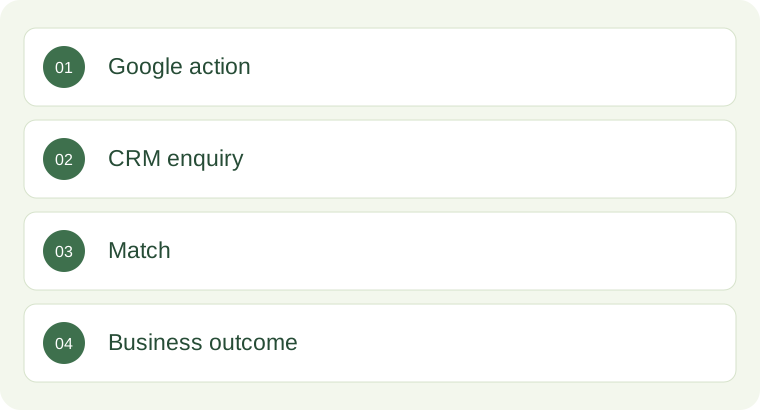
Start with an ordinary customer path. Someone clicks an ad, visits a page, calls the business and later submits a form. Reception creates an enquiry record, books an appointment and adds an outcome after the appointment. Depending on configuration, the advertising tools may record several events while the CRM represents one person with several activities. Neither number can be interpreted properly without knowing the intended counting rules.
Use a fictional test person to check that journey. Confirm the source, service request, timestamp, owner and next action. Check whether the call and form join the same contact when appropriate, whether a new opportunity is created and whether the booking appears in the correct place. Do not rely only on a success screen. The useful test is whether the next member of the team can find the record and act on it.
Repeat the test for realistic variations. A person may use a different email address, call from a shared number or return after several weeks. The aim is not to eliminate every possible ambiguity. It is to identify predictable issues, document how they are handled and avoid counting the same commercial opportunity repeatedly simply because it touched more than one channel.
Separate enquiry quality from attribution completeness
An enquiry can be valuable even when its marketing source is unknown. Equally, a perfectly attributed call may be irrelevant. These are separate dimensions. The business needs to know both whether the person is suitable and whether the source can be connected confidently to the campaign. Treating an unattributed enquiry as worthless will distort the commercial review and encourage the team to fill missing fields with guesses.
Use an honest unknown category. If a caller cannot be connected to a source, record that uncertainty rather than assigning the enquiry to whichever campaign spent the most that day. Review why information is missing. The website may not preserve useful campaign data, call tracking may be incomplete, or staff may create records outside the agreed process. Different causes require different fixes.
A useful daily report separates all incoming enquiries, Google-attributed enquiries and unclassified enquiries. It also shows suitability and progression. That makes it possible to investigate the measurement gap without pretending that attribution is perfect. Over time, the team can improve completeness while still responding promptly to people who need help. Measurement should support customer handling, not interrupt it.
Reconcile by cohort and allow for time
A same-day advertising total and a same-day sales total may describe different groups of people. A customer who accepts a quotation today may have first enquired last month. A campaign click today may not become an appointment until next week. Comparing them as if they all happened in a single instant can produce misleading conclusions about return and acquisition cost.
Choose a review method that suits the decision. A daily operational report can show what arrived and what needs attention today. A campaign cohort review can follow enquiries created during a chosen period through later outcomes. Both views are useful, but they answer different questions. Label the period and explain whether the report is showing activity that occurred during it or outcomes attached to people who first entered during it.
Consider a hypothetical business that spends AUD$3,000 this month and wins five jobs today. Dividing that spend by today’s jobs does not establish the campaign’s customer acquisition cost unless those jobs belong to the relevant enquiry group and the reporting period is appropriate. The calculation may still be useful as a daily activity ratio, but its label must not imply a stronger conclusion than the data supports.
Design the CRM fields around decisions
A CRM needs enough structure to explain outcomes without making staff complete an excessive questionnaire. Useful fields often include service, location, source, assigned owner, qualification status, appointment status and outcome. The exact list should follow the business process. A clinic’s consultation journey should not be forced into a trade company’s quotation stages merely because a generic template is available.
Define which fields are required at each point. Reception may collect basic details immediately, while the clinician or estimator records the later commercial outcome. It is unreasonable to demand information from the first responder that only becomes available after an assessment. A staged process creates better records because each person contributes what they actually know, at the time they know it.
Add a small number of loss reasons that lead to action. Outside area, unsuitable service, unavailable capacity, no response and chose another provider tell different stories. A single lost label cannot distinguish them. Review the categories periodically, but resist changing them every week. Consistent records make trends visible. Constantly revised definitions make past and present performance difficult to compare.
Feed reliable outcomes back carefully
Google supports importing offline outcomes so advertising measurement can include selected actions that occur after the original online interaction. Enhanced conversions for leads is one supported approach. The implementation method, customer-data requirements and current platform rules must be checked for the account. This should be treated as a measured integration project, not as permission to upload every field held by the business.
Decide which outcome is useful enough to inform optimisation. A qualified enquiry, an attended appointment and accepted work each represent different levels of commercial progress. If an outcome is recorded inconsistently or too late to be useful, begin by improving the operational process. Sending unreliable labels into another system does not make them more reliable; it distributes the same uncertainty to another dashboard.
Test matching, timing, duplicates and failure handling before relying on the connection. Someone should know when an upload fails, who investigates it and how corrected records are handled. You do not need to manage those technical details personally, but should know which business outcome is being shared and why. The integration should preserve a clear distinction between actual records, inferred attribution and estimated value.
Build a report that makes gaps visible
A good report can show separate layers: advertising activity, recorded enquiries, qualified opportunities, bookings, attended appointments and accepted or completed work. It should also identify missing outcomes. A beautiful funnel that excludes every unclassified record may look stronger than the business actually is. The missing-data count belongs in the conversation because it affects how confidently the rest of the report can be interpreted.
Keep the daily summary short enough to read. You might need spend, new enquiries, important stage changes, unanswered opportunities and one recommended next action. Detailed tables can sit beneath that summary for investigation. This gives the business clarity without requiring everyone to become an analyst. The best reporting structure serves both quick operational awareness and a more careful commercial review.
Avoid changing metric names to make the story sound better. Cost per Google conversion, cost per CRM enquiry and cost per acquired customer are different ratios. Show the formula or definition where it helps. If the result is based only on ad spend, say so. If the customer value is accepted work rather than money collected, retain that distinction throughout the report.
Make measurement a shared operating habit
The advertising manager cannot create complete customer outcomes alone. Reception, sales, clinical or field teams and management all contribute pieces of the picture. Assigning ownership makes the process sustainable. The team should know who records a booking, who closes an opportunity, who checks missing fields and who decides whether the campaign is producing commercially useful demand.
A practical weekly check can use five real records. Follow each from its first interaction through the latest next action. Look for unclear ownership, missing source information, duplicate opportunities and outdated statuses. Correct the process behind repeated errors rather than endlessly cleaning individual records. Small, regular checks are often more useful than a large reconstruction exercise after several months of incomplete information.
We connect Google Ads, call and form tracking, VentaOne CRM, agreed automations and reporting around your actual customer journey. The aim is not to make every dashboard display an identical total. It is to help you understand what each number means, where opportunities are being lost and which next action is justified. If your current reports disagree, we can help establish the definitions, test the handoffs and build a clearer view from first enquiry to recorded result.
Let’s put this to work in your business
Show me the two reports that don’t seem to agree. We’ll define each measure, trace a small set of enquiries and check timing, duplicates and missing sources. I’ll explain what the figures support and what we still need to verify. Where a tracking or CRM connection needs work, we can scope that repair before you use the numbers to make a bigger budget decision.
KEEP READING

Clicks, enquiries and bookings are different numbers
If your ads report looks healthy but your diary tells a different story, I want you to look beyond clicks.

Why the cheapest leads can be the most expensive to your business
I’d rather show you an enquiry that became worthwhile work than celebrate a cheap lead your team couldn’t use. If your cost per lead looks good but the calls are unsuitable, we need to look further down the journey.

What a daily business report should help you decide
I don’t want to send you a long report and leave you to work out what matters. Your daily update should show what came in, what became a booking and what needs attention next.