Numbers & reporting
Why the cheapest leads can be the most expensive to your business
I’d rather show you an enquiry that became worthwhile work than celebrate a cheap lead your team couldn’t use. If your cost per lead looks good but the calls are unsuitable, we need to look further down the journey. I’ll help you compare the quality, effort and recorded outcomes behind the headline price, then decide whether the problem is targeting, the offer, the page or the follow-up.

Published · Updated

Decide what a lead actually is
Before comparing prices, define what is being counted. One provider may call every submitted form a lead. Another may count tracked calls, including repeat callers. Your team may use the word only for people who need an offered service and can be contacted. These definitions create very different cost-per-lead figures. A comparison is not meaningful until the counting rules are clear.
Write a simple definition for the first enquiry and a separate definition for a qualified opportunity. The first can describe an identifiable person requesting help. The second should reflect the service, area, timing and other requirements relevant to the business. Avoid making qualification so strict that staff exclude every uncertain prospect. The aim is to distinguish useful demand from clear mismatches, not to make the report look selective.
Keep duplicate handling visible. A call followed by a form may represent one commercial opportunity with two interactions. An existing customer asking about an appointment is different from a new customer enquiry. These distinctions do not make either interaction unimportant. They make the report more accurate, so an owner can understand what the campaign is generating rather than paying attention to a deceptively simple total.
Calculate what the cheap enquiry becomes
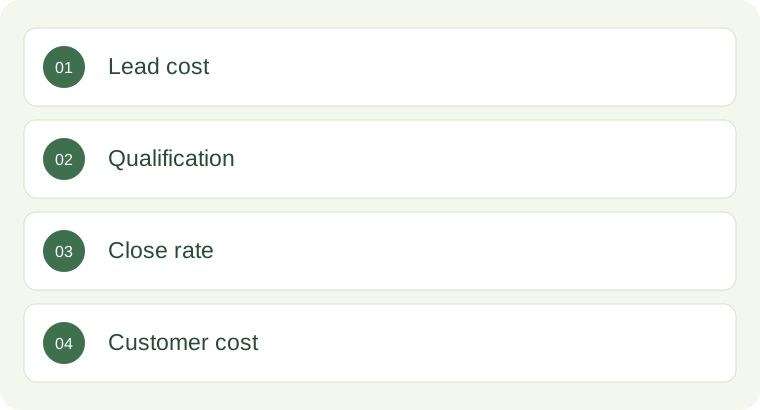
A cheap enquiry is valuable when it progresses into suitable work at a sensible overall cost. It is less valuable when it creates repeated administration without a realistic opportunity. Follow the journey through contact, qualification, booking, attendance, quotation and accepted work as appropriate. Different businesses need different stages, but each should know where the largest loss of suitable opportunities occurs.
Consider two hypothetical campaigns. Campaign A spends AUD$2,000 on forty enquiries, so its media cost is AUD$50 per enquiry. Campaign B spends AUD$2,000 on twenty enquiries, or AUD$100 each. If A produces two accepted customers and B produces five, their media cost per acquired customer is AUD$1,000 and AUD$400 respectively. This example is arithmetic, not a promised campaign result. It shows why the cheapest initial number can support the wrong decision.
Include the quality of the accepted work. Five low-value jobs may not be commercially better than two suitable larger jobs, especially when delivery costs differ. You need your agreed commercial model alongside the enquiry figures. Marketing reports should help that discussion without pretending to determine profit from sales value alone. A cheap lead is an input to a business process, not the final evidence that the process is worthwhile.
Count the operational cost of unsuitable demand
Every enquiry uses attention. Staff answer questions, check availability, find addresses, prepare estimates and follow up. A stream of unsuitable calls can consume time that should be spent helping genuine customers. The cost is not always visible in the advertising account, but it affects the operation. This is why reception feedback belongs in campaign management rather than being treated as an unrelated complaint.
Record a small number of suitability reasons. Wrong service, outside area, employment enquiry, supplier enquiry and unavailable capacity are useful distinctions. They point to different actions. The advertising manager might change exclusions, the page might need clearer scope or the business might need to stop promoting an unavailable service. A general statement that the leads are bad does not identify which action would help.
Be careful not to confuse administrative difficulty with customer quality. Someone asking sensible questions about price, timing or process is not automatically a poor prospect. Your business should explain its offer clearly and respond respectfully. Qualification should assess whether the service is a fit, not whether the customer behaves like an idealised sales script. Clear expectations can reduce unnecessary work without dismissing legitimate questions.
Check whether the offer attracts the wrong expectation
A campaign designed around an appealing but unclear offer can produce cheap responses that do not fit the business. The page may emphasise an introductory discussion without explaining the larger service. An ad may suggest immediate availability that reception cannot provide. A form may collect contact details without giving the person enough information to understand why someone will call. Cheap interest is not the same as informed demand.
Review the promise from the customer’s perspective. What would a reasonable person expect after reading the ad and page? Does the business deliver that experience? If you want qualified installation quotes but your message sounds like general free advice, the mismatch should be addressed in the offer and page. Adding more form questions may help, but it should not become a substitute for explaining the service properly.
Use qualification questions only when their answers guide a real decision. Service type, location, timing and project scope can be useful. A long application filled with questions nobody reads adds friction without improving delivery. The right balance depends on the value and complexity of the service. Make each question earn its place by explaining who uses the answer and what happens because of it.
Separate traffic problems from response problems
Suitable enquiries can appear weak when the business does not respond well. Missed calls, slow callbacks, unclear ownership and inconsistent follow-up all reduce the chance that a genuine opportunity becomes work. If the campaign is changed before these issues are examined, the business may buy different traffic while leaving the same operational loss in place.
Review a small set of recent enquiries in detail. When did each arrive? Who was assigned? When was contact attempted? What did the person need? What was the next action? This exercise should use records rather than recollection. The purpose is not to blame staff. It is to find whether the system gives them a workable process and whether capacity matches the level of demand being purchased.
Keep the advertising team involved in that review. They need to know whether apparently poor outcomes reflect irrelevant searches, misleading copy or a response process that needs attention. The business needs to know when targeting or messaging is contributing to the problem. A shared view makes it easier to choose the next improvement, instead of allowing marketing and operations to maintain competing explanations of the same enquiry.
Compare campaigns using consistent commercial measures
A useful comparison uses the same service definition, period, counting method and outcome rules. Cost per enquiry can remain in the report, but it should sit beside suitability, booking progression and recorded customer outcomes. Show missing data too. If many opportunities have no final status, the apparent acquisition cost is incomplete and should not be presented as a settled result.
Allow for the decision cycle. Enquiries created this week may still be waiting for appointments or quotes. A campaign aimed at significant renovations needs time for those opportunities to progress. Compare relevant groups over appropriate periods rather than dividing today’s spend by today’s accepted jobs. The daily operational view and the longer commercial view can coexist, provided their labels explain what each one means.
Avoid building a winner around a single attractive metric. A lower enquiry cost may accompany a lower qualification rate. A higher click cost may accompany a stronger service fit. More bookings may be unhelpful if attendance is poor. You should be able to see the chain of measures and understand the main constraint. That is more useful than a report that celebrates whichever number improved most recently.
Improve the weakest meaningful handoff
Once the journey is visible, choose a specific improvement. If searches are unrelated, review targeting and exclusions. If relevant visitors do not enquire, investigate the page and offer. If suitable enquiries do not book, examine contact and qualification. If appointments do not become accepted work, review the relevant sales or service process. Each problem has a different owner and a different test.
Write down the expected effect before making the change. For example, clarifying the service area may reduce total enquiries while improving the share the business can serve. That can be a good outcome even if cost per enquiry rises. Without an agreed measure, you could reject a useful change simply because the old headline number looked better. The report should help everyone recognise what success would actually look like.
Give the change enough observation to be useful, while correcting obvious faults promptly. Do not use patience as an excuse for broken systems, and do not use urgency as a reason to rewrite everything after one difficult call. A disciplined review combines timely action with realistic judgement. It helps the business learn from demand instead of reacting to every fluctuation as a verdict on the entire marketing strategy.
Buy a clearer process, not a flattering lead price
We connect Google Ads, conversion-focused pages, call tracking, VentaOne CRM, follow-up and reporting around the work your business wants. The purpose is to understand how enquiries progress and improve the handoffs that affect their commercial value. A low lead price can be useful, but it should never replace a clear view of suitability, customer handling and recorded outcomes.
Bring examples from your current enquiry process to the first review. A few suitable opportunities, a few unsuitable ones and a few that disappeared without a clear outcome can reveal where the system needs attention. We can help identify what is known, what needs better records and which changes belong in advertising, the website or the operation. The result should be a practical sequence of improvements with clear owners.
If a campaign report feels positive while your team feels overwhelmed, the answer may be hidden between the click and the completed work. Start by agreeing what a useful opportunity means and following actual records through the business. We make that journey visible through your tracking, CRM and reports, so you can judge marketing by the work it helps you win.
Let’s put this to work in your business
Bring your lead-cost report and a sample of the calls your team found unsuitable. I’ll review the promise in the ad, the page and what actually arrived. We can then agree a more useful measure of success and a focused change to test. You should be able to see why an enquiry is valuable, rather than being asked to accept a low price as proof the campaign works.
KEEP READING

Clicks, enquiries and bookings are different numbers
If your ads report looks healthy but your diary tells a different story, I want you to look beyond clicks.

Why Google conversions and CRM enquiries rarely match exactly
Your Google Ads account and CRM can show different totals without either being broken. The first thing I’ll ask is what each number counts.

What a daily business report should help you decide
I don’t want to send you a long report and leave you to work out what matters. Your daily update should show what came in, what became a booking and what needs attention next.