Numbers & reporting
What a daily business report should help you decide
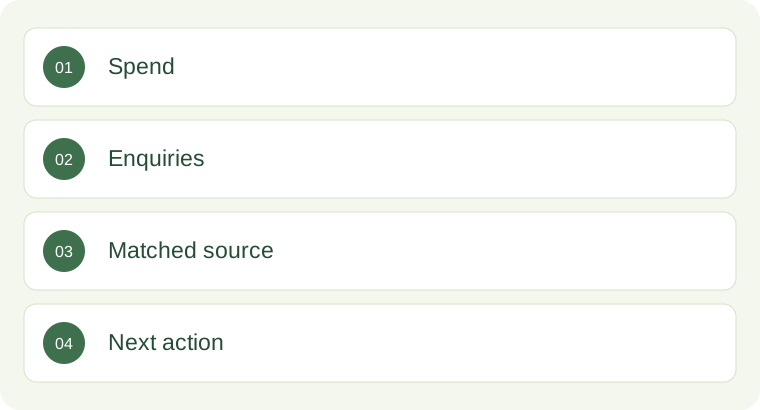
I don’t want to send you a long report and leave you to work out what matters. Your daily update should show what came in, what became a booking and what needs attention next. I’ll explain how we separate Google Ads figures from CRM outcomes and keep the summary useful, so you can see the business picture quickly and open the detail when you need it.

Published · Updated

Begin with the decisions the owner needs to make
A report should answer practical questions. Are suitable enquiries arriving? Is the team responding? Are appointments or quotes progressing? Is advertising spend within the agreed plan? Are there missing outcomes that prevent the business from understanding the result? Start with those decisions and choose the measures that support them.
You do not need every number available in every platform. A long report can create the appearance of transparency while hiding the few items that require action. Put the operational summary first, followed by the supporting figures. Someone who reads only the opening section should understand the main changes, the unresolved questions and who will investigate them.
A daily report also has limits. It can show a change in demand or a queue that needs attention, but a single day may not establish a dependable marketing trend. A business with a long quoting cycle should not judge campaigns solely by work won that afternoon. Match the decision to the period over which the underlying process actually unfolds.
Keep the stages of the journey separate
Advertising impressions, clicks and conversions describe activity within the advertising setup. CRM enquiries describe records received and classified by the business. Bookings describe agreed appointments or visits. Completed work, accepted treatment and payments are later outcomes. A useful report preserves these distinctions so you can see where movement is occurring and where the data is incomplete.
For example, imagine a hypothetical day with twenty advertising conversions, fourteen new CRM enquiries and six appointments booked. Those numbers do not automatically contradict one another. The conversion setup may include several actions, some callers may be existing customers, and bookings may relate to enquiries received on earlier days. The report should explain the definitions rather than force the totals to match.
Give each metric a plain-language label. Cost per enquiry is different from cost per booked appointment or cost per acquired customer. Avoid a generic CPA label without stating the denominator. Otherwise, two people can discuss the same number while imagining completely different outcomes, making budget and delivery conversations unnecessarily confusing.
Show what the team needs to do today
The most useful daily section is often an exception list. It might identify new enquiries without an owner, unanswered replies, overdue callbacks, quotes awaiting review and appointments that still need confirmation. Each item should lead to a record or a clear action, rather than leaving you to search several systems for the context.
Keep the list short enough to act on. Group similar items and assign responsibility. Three unassigned renovation enquiries need review by the sales coordinator is clearer than a general statement that follow-up should improve. Include the time period and the definition used to identify the exception, so the team can determine whether it reflects a real problem or a reporting error.
Separate this operational queue from strategic recommendations. The receptionist can resolve a callback today. Changing a campaign structure may require a considered review of search demand, conversion data and delivery capacity. Mixing both into a long list of urgent instructions can distract the team from the customer commitments that need immediate attention.
Treat attribution as evidence with boundaries
Not every enquiry will have a reliable source attached. Someone may see an advertisement, return through a different route and call later. A customer may use a tracking number or a normal business number. Staff may record a referral after the first conversation. A report should identify known attribution and leave unknown attribution visible rather than allocating it confidently to the preferred channel.
Explain how the source was established. An advertising click identifier, a tracked call and a customer's self-reported answer are different kinds of evidence. They can all be useful, but they should not be treated as identical. Where systems are connected, document which events and fields are passed and what gaps remain.
You should be able to ask what would change the interpretation. If a large share of enquiries is unattributed, the next action may be improving capture and record quality before making a confident channel comparison. A report that admits this limitation is more useful than one that produces an exact-looking return figure from incomplete information.
Connect commercial outcomes without overstating revenue
An accepted quote, a booked job, a completed service, an issued invoice and money received are different events. Report whichever outcomes the business can reliably record, using accurate labels. Accepted treatment value is not necessarily cash collected. A large invoice total is not necessarily the business's own service revenue if it contains pass-through amounts or other charges.
Use the business's agreed definitions and get appropriate accounting input where needed. The reporting setup should not invent a revenue policy or tax treatment. Its job is to present operational information consistently and identify what was recorded. If payment status is unavailable, say so rather than assuming that every accepted job was fully paid.
In a hypothetical installation business, the report might show a quote accepted this week, a deposit paid later and the remaining invoice settled after delivery. Showing those events separately helps you understand both pipeline progress and cash collection. It also avoids attributing today's advertising spend directly to every payment received today from work won months earlier.
Compare meaningful periods and comparable services
Daily figures can move sharply when enquiry volumes are small. One additional booked consultation may make a percentage appear dramatically better. Use a daily view for operational attention and longer comparisons for patterns. Agree a review period appropriate to the buying cycle, the spend and the number of opportunities involved.
Compare like with like where possible. A routine veterinary appointment and a substantial dental treatment enquiry have different values and decision processes. A heating repair and a new system installation may require different qualification. Combining everything into a single average can hide a weak service category behind a strong one or encourage the wrong budget decision.
When a change appears, investigate the context. Did opening hours change? Was the receptionist absent? Did the business reach its appointment capacity? Did a campaign start targeting a new area? These operational factors belong in the discussion alongside advertising settings. A report should make those questions easier to ask, rather than implying that every variation is caused by the campaign alone.
Make the report easy to read and easy to verify
Use a predictable structure: a short summary, advertising figures, enquiry and booking outcomes, exceptions and agreed next actions. Show the reporting date, timezone and data period. If some systems update later than others, explain the timing. A report assembled before the day's bookings are entered will look different from a final reconciled view.
Link summary figures to the underlying records where access permits. You should be able to inspect the enquiries behind a total and see how the outcome was classified. This is especially important when the report combines advertising data and CRM information. A polished chart is useful only when the definitions and source records support it.
Avoid invented precision in commentary. If the data does not explain why enquiries changed, frame the explanation as something to investigate. Statements such as the lower booking count may relate to reduced availability are more responsible when the availability data has not yet been checked. The report should distinguish observation, interpretation and the next test.
Agree how corrections will be handled. If an enquiry was duplicated or an outcome entered against the wrong record, the report should be updated through a controlled process. Keep a note of material corrections so a later comparison does not rely on an old screenshot. Reliable reporting depends on the ability to improve inaccurate information, not on pretending the first version is beyond question. The team should feel able to flag a discrepancy without turning every correction into a dispute about performance.
Establish a review rhythm that leads to improvement
Decide who receives the daily report, who handles exceptions and which questions belong in the regular review. Daily reporting should not become a stream of messages that nobody owns. A simple rhythm might combine an operational check each working day with a scheduled conversation about patterns, commercial outcomes and the next improvement.
Keep a record of decisions. If the team changes the enquiry form, reception process or campaign focus, note when it happened and what the change was intended to improve. This helps avoid reviewing a later result without remembering that the operating conditions changed. It also makes the next conversation more concrete than repeating the same broad concerns.
We connect advertising, enquiry tracking, VentaOne records and agreed business outcomes into reporting that supports action. We define the measures with your team and show where the information is incomplete. The purpose of a daily report is clear ownership and a better next decision, with longer-term improvement guided by evidence rather than the appearance of a busy dashboard.
Let’s put this to work in your business
Bring the report you currently receive and tell me what it still leaves you wondering. I’ll help you define the few daily figures and actions you actually need. We can then connect the available advertising and CRM data, flag missing information and agree who follows up. You should be able to read the opening summary and know whether anything needs your attention today.
KEEP READING

Clicks, enquiries and bookings are different numbers
If your ads report looks healthy but your diary tells a different story, I want you to look beyond clicks.

Why Google conversions and CRM enquiries rarely match exactly
Your Google Ads account and CRM can show different totals without either being broken. The first thing I’ll ask is what each number counts.

Why the cheapest leads can be the most expensive to your business
I’d rather show you an enquiry that became worthwhile work than celebrate a cheap lead your team couldn’t use. If your cost per lead looks good but the calls are unsuitable, we need to look further down the journey.