Growth planning
Work out what a booking can cost your business
Before you ask me how much a booking should cost, I’ll ask what that booking is worth to your business after you deliver the work. My job is to connect your marketing with the way your business actually operates. Let’s work backwards from a paying customer, include the costs that matter and find a sensible starting point for your budget. A cheap booking is useful only when the work behind it makes sense.

Published · Updated

Decide which booking you are planning around
A booking can mean several things. It might be an introductory call, a clinical consultation, a site inspection or a quotation visit. Those events use different amounts of time and lead to different commercial decisions. Start by naming the exact booking the campaign is intended to produce. Without that definition, an apparently attractive acquisition figure can compare events that have very different value to the business.
Describe what makes the booking suitable. That may include an offered service, an appropriate location, a realistic timeframe and a person who understands the next step. Qualification should be proportionate to the service. A simple appointment should not require a lengthy application, while a significant renovation may need more context before an estimator commits time. The purpose is a useful customer conversation, not an unnecessarily difficult gate.
Separate booked from attended. A business can invest in filling appointments and still lose value through missed visits or unsuitable bookings. Your model should include what normally happens after the calendar event is created. This creates a fairer planning conversation because advertising, reminders, reception and the eventual service decision are all visible, rather than treating the booking as the finish line.
Establish the value after delivery costs
Begin with the expected value of the work and the direct costs of providing it. The difference gives a starting view of what is available before other business costs and the desired return are considered. Use figures your business can support, and ask your finance adviser to help define the cost model where needed. Marketing planning should not quietly substitute turnover for contribution or profit.
For a hypothetical example, a service sells for A$4,000 and has A$2,400 in direct delivery costs. The remaining A$1,600 is not automatically available for marketing. The business still needs to cover its other costs and retain a return. If management provisionally allocates A$500 to winning an additional customer, that becomes a planning allowance to test against the acquisition process, not a claim about what advertising will achieve.
Use a realistic service mix. A company may promote a category that includes jobs with very different values and delivery requirements. An average based on a few unusually large projects can make the allowable acquisition cost look much more generous than normal trading supports. Review the typical work the business wants more of, and keep exceptional cases separate so they do not distort the starting assumptions.
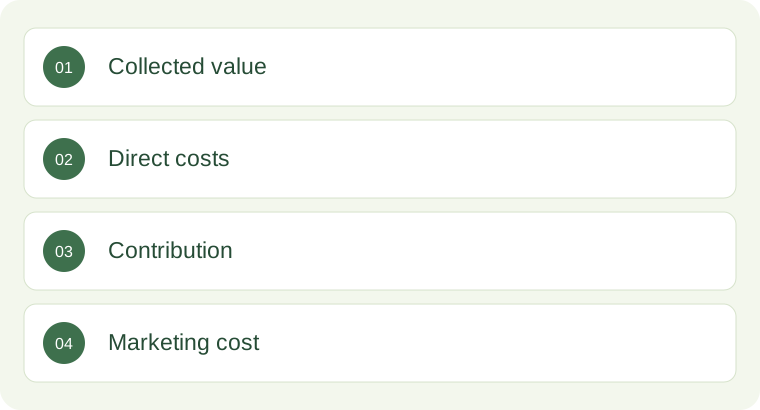
Work backwards from customer to attended booking
The cost of acquiring a booking depends partly on how often that booking becomes accepted work. Suppose, hypothetically, one in four attended quote visits becomes a customer and the provisional acquisition allowance is A$500 per customer. The corresponding allowance per attended visit would be A$125 before deciding how shared acquisition costs are allocated. If one in two becomes a customer, the equivalent allowance is A$250. The conversion process changes the commercial room available.
This does not mean the team should pressure every person into proceeding. The purpose of a consultation or quotation is to establish fit and provide a professional next step. A lower acceptance rate can reflect unsuitable demand, but it can also reflect capacity, offer clarity, pricing, timing or ordinary customer choice. The model identifies a question to investigate. It should not become an excuse for manipulative selling.
Use your actual records when they are reliable. If they are not, label the assumption and choose a sensible review period. The first task may be to record attendance and outcomes consistently rather than refine the spreadsheet further. An approximate model with visible assumptions can guide a test. A precise-looking model built on invented conversion rates gives the business false confidence without improving the underlying decision.
Include the effect of missed appointments
A booking that is not attended consumes some acquisition and administration effort without reaching the intended conversation. If attendance is part of the journey, include it explicitly. A simple model can connect recorded enquiries, suitable bookings, attendance and accepted work. This helps identify whether the next improvement belongs in the campaign, the booking process or the communication around the appointment.
For a hypothetical example, suppose the attended-visit allowance is A$125 and four out of five bookings are attended. The equivalent provisional allowance per booking is A$100, because not every calendar event reaches the attended stage. This is not an industry benchmark. It is an illustration of why the attendance assumption matters. Your business should use its own records and distinguish cancellations, rescheduling and unexplained non-attendance.
Review what the customer is told before the appointment. Clear confirmation, an accurate location, an explanation of what will happen and an appropriate reminder can reduce avoidable confusion. The exact process should suit the business and its customers. The point is to manage the booking deliberately, rather than assuming that creating the event completes the operational responsibility and any later loss must be a marketing problem.
Account for the full acquisition investment
Media spend is only one part of the acquisition system. Agency management, page production, tracking, CRM work and agreed reception or content support may also contribute to the process. Keep media-only measures available for campaign management, but show you how the wider investment fits the commercial model. A cost per booking without a stated cost basis is incomplete.
Decide how one-off work will be assessed. A website build or initial tracking setup may support the business beyond the first month, while ongoing management is recurring. There is no single allocation rule that suits every decision. What matters is that the business agrees a method and uses it consistently. Your finance adviser can help determine the appropriate treatment for business reporting; marketing reviews should make their chosen comparison clear.
Do not hide a weak proposition behind a long assumed payback period. If the initial economics are uncertain, say what needs to be learned and how much the business is comfortable investing in that learning. The acquisition plan should support a deliberate decision about risk and capacity. It should not rely on a vague suggestion that future repeat business will eventually make every current cost acceptable.
Test the model against capacity and timing
A profitable service can still be unsuitable for immediate promotion if the business cannot deliver more of it. Check available consultation time, quotation capacity, stock, clinicians, technicians or crews as relevant. The value of an additional booking changes when the next available appointment is far away or the business cannot complete accepted work within the customer’s timeframe. Capacity belongs in the model before a campaign expands.
Consider the timing between investment and outcome. Some services are accepted quickly; others require several conversations, an assessment or a detailed quote. A daily report can show activity, but the commercial review needs to allow those opportunities to mature. Use enquiry groups or cohorts where helpful, rather than assuming that the month a job is accepted is also the month its acquisition effort occurred.
Create a simple capacity notification routine. The marketing team should hear when staff become unavailable, a schedule opens or a service is temporarily paused. Reception should know which bookings the campaign is currently trying to create. This shared information helps prevent advertising from buying demand that the business cannot handle. A useful model stays connected to the operation instead of remaining a static calculation from the sales meeting.
Choose a starting test and decision rules
A planning model should lead to an action. Choose one service, a sensible area, an approved investment and a clear measurement process. State which assumptions are already supported and which the test will investigate. Also state what would justify an early repair or review. Broken tracking and an unanswered enquiry queue should not wait until the scheduled end of a testing period.
Agree how the result will be interpreted. Suitable enquiries with weak booking progression may suggest a response or page issue. Healthy bookings with poor attendance may suggest a communication or scheduling problem. Relevant demand with unattractive delivery economics may require a different offer or service priority. The calculation does not diagnose the cause by itself. It helps the team recognise which part of the journey needs attention.
Keep changes focused enough to learn from them. If the service, targeting, page and follow-up all change at once, later performance becomes harder to interpret. Sometimes a larger reset is sensible, but it should be recognised as a new test. Otherwise, document the hypothesis, make the appropriate improvement and review the relevant records after enough of the normal customer cycle has passed to provide useful evidence.
Turn the calculation into a clearer operating system
We can help connect the numbers to the practical work: Google Ads, conversion-focused pages, call and form tracking, VentaOne CRM, appointment follow-up and reporting. The goal is a visible path from investment to recorded opportunity and outcome. A calculator is useful when it prompts the right questions; it becomes more useful when the business can check its assumptions against reliable records.
Bring your typical service values, direct costs, current booking and attendance information, available capacity and existing marketing spend to the discussion. Where information is missing, we can identify the records and handoffs needed before making a confident recommendation. The scope should make responsibilities clear, including what we manage and what your team needs to approve or record as customers progress.
If you cannot yet answer what a booking can cost, you do not need a fabricated benchmark to begin. You need a transparent model, a controlled starting test and a process for improving the evidence. Our planning, acquisition and enquiry-management work is designed to connect those pieces, so future budget decisions are based on the service your business delivers and the outcomes it can actually demonstrate.
Let’s put this to work in your business
Start with one service you want more of. Bring its typical collected value, direct costs and your recent booking outcomes. I’ll help you put those figures into a clear planning model, identify the assumptions we still need to test and connect the model to your ads, pages and enquiry follow-up. You’ll know what we’re testing before you decide to invest.
KEEP READING

Build a marketing plan around the work your team can actually deliver
Before I recommend more enquiries, I want to know which work you actually want and how much your team can take. A useful growth plan connects your services, margins, available capacity and the way you handle each opportunity.

Clicks, enquiries and bookings are different numbers
If your ads report looks healthy but your diary tells a different story, I want you to look beyond clicks.

Give every missed enquiry a clear next step
When someone calls and nobody answers, I don’t want your team guessing who should call back. I want one record, one responsible person and a clear next action.