CRM & operations
Give every missed enquiry a clear next step
When someone calls and nobody answers, I don’t want your team guessing who should call back. I want one record, one responsible person and a clear next action. This is the process I’d help you put in place before asking you to buy more enquiries. We’ll look at missed calls, unanswered forms and the small handoffs that can quietly lose work, then turn them into a queue your team can manage.

Published · Updated

Find the places where an enquiry can wait unnoticed
Start by listing every route into the business. Include advertising numbers, the main phone line, website forms, booking requests, email, social messages and any enquiry channel the team actively offers. An owner may know where the main calls arrive but be unaware that a second form still sends to an old inbox. The first task is visibility, not a new message sequence.
Ask a team member to show the most recent unanswered item in each channel. Record when it arrived, where it appears and who is expected to act. If nobody can answer those questions reliably, the business has found a practical improvement. A missed enquiry is difficult to recover when the team does not know it exists or assumes another person is handling it.
Do not start by accusing staff of being slow. The enquiry may arrive during a busy reception period, reach the wrong address or lack the details needed for a callback. Understanding the actual situation helps distinguish coverage, routing, record quality and training problems. Each needs a different response, and a reminder alone cannot solve all of them.
Create one recoverable record
The recovery process needs a central record with enough information to continue the conversation. Capture the contact details available, arrival time, channel, requested service and relevant message. If the caller is already known, link the event to the existing customer where appropriate rather than creating an unnecessary duplicate. Preserve the original context so the receiving person can see what happened.
Some enquiries will contain incomplete information. A missed call may provide only a number. A form may contain an incorrect email address. Record that limitation rather than filling the gap with a guess. The next action may be to verify the details, not to move the opportunity into a more advanced sales stage.
Decide which system will hold this working record. It might be VentaOne or another CRM already used by the business. Email and WhatsApp can notify the team, but neither should be the only place where the recovery status lives if several people need to coordinate. You should be able to find the current action without reconstructing a scattered conversation.
Name the owner and the backup
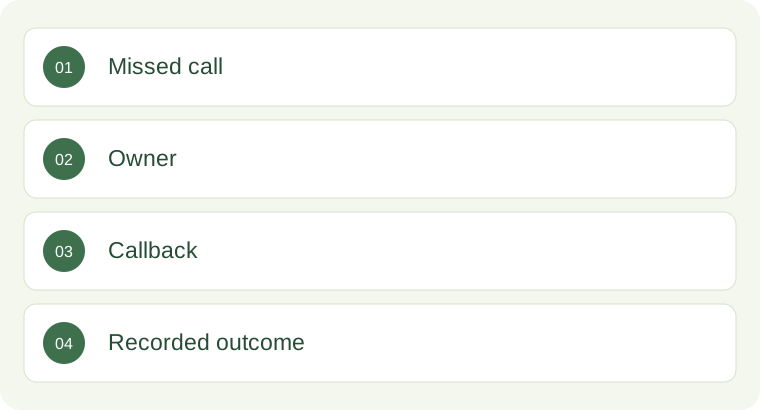
Give each recoverable enquiry one accountable owner. That person is responsible for the next attempt and for recording the result, even if someone else provides specialist input. A shared inbox can support the process, but shared visibility is not the same as shared responsibility. Without assignment, several staff may each assume the enquiry has been handled.
Agree a backup rule for absence and busy periods. If the usual receptionist is away, who reviews the queue? If an estimator cannot return the call, who tells the customer what to expect? These situations occur in normal business, so the process should not rely on an informal favour from whoever happens to see the message.
Use the team roster and service responsibilities to make assignment practical. A clinic may route a consultation request to reception while reserving clinical questions for an appropriate practitioner. A trade company may assign a particular area to an estimator. You remain responsible for ensuring that the arrangement is adequately staffed rather than expecting the CRM to create capacity by itself.
Make the first response accurate and useful
An acknowledgement should tell the customer what the business has received and what will happen next. It can provide a suitable contact route, ask for a missing detail or confirm when the team normally responds. Avoid implying that a person has reviewed the request if the message is automated. Clear expectations are more valuable than a warm but misleading promise.
The actual callback should use the context already available. A caller who described a roof restoration should not have to start again because the message was never attached to the record. Confirm the request, check whether the business can help and explain the next decision. The purpose is to restore a useful conversation, not merely to mark an attempt as completed.
If the business cannot meet the customer's timing or service need, say so appropriately and record the outcome. Recovery does not mean pursuing every enquiry indefinitely. A respectful and accurate answer can be the correct result even when it does not become a booking. The process should help the team recognise fit and limitations early.
Agree a proportionate follow-up sequence
Set a follow-up approach that matches the service and the customer's preferences. A routine appointment request may need a different rhythm from a substantial renovation project. Decide the permitted channels, the number of attempts, the interval and the stopping conditions. You should be able to explain why the sequence is reasonable, not simply copy the most aggressive template available.
A follow-up should add context or help the customer take the next step. It might offer suitable times, clarify the information needed for a quote or ask whether the request is still current. Repeatedly sending the same generic message can make a careful local business seem inattentive. Where a customer asks to stop or declines, the workflow should respect that response and applicable messaging requirements.
Record meaningful replies before continuing a sequence. If the customer asks a specific question, a person may need to respond rather than allowing the next scheduled message to ignore it. An automation is useful for dependable reminders, but it should not override a genuine conversation or keep contacting someone after the agreed recovery process has ended.
Use outcomes that explain what happened
A callback attempted is an action, not a successful recovery. Distinguish no answer, contact made, unsuitable service, outside area, appointment booked, customer declined and no further follow-up required. The exact labels can be adapted, but they should help you understand why the enquiry did or did not progress.
Do not label every missed call as a lost new customer. Some are existing customers, suppliers, repeat attempts or unrelated calls. Classification may only become possible after contact. A report that counts each ring as a separate prospect can exaggerate the problem and distort the apparent advertising result. Preserve unknown status where the available information does not support a more definite answer.
If a booking is arranged, record the agreed time and next responsibility. If the customer needs to send information, schedule the review rather than leaving an open-ended note. The central question is whether someone can look at the record tomorrow and understand what they are supposed to do. A useful status always supports a real next action or a clear closure.
Test the recovery process as a customer
Use labelled test details and an appropriate controlled destination to check each advertised route. Call during a coverage gap, submit a form with complete details and try a request with a missing field. Confirm that the record appears, the right person is notified and the customer-facing acknowledgement matches the actual response arrangement.
Ask the receiving team member to complete the next step without being coached. Can they find the service requested? Do they know which number or channel to use? Can they record a reply and stop an unnecessary reminder? This reveals operational gaps that a successful form submission alone would not expose.
Also test the awkward cases. Try an existing customer, a duplicate form and a changed appointment. Confirm that a failed connection creates a visible exception rather than quietly dropping the enquiry. HighLevel's official API documentation describes resources that can support connected records and events, but the specific behaviour must be verified in the business's own setup. Account access and supported integrations affect what can be automated.
Keep the test results beside the operating instructions. When someone changes a form or notification later, the team can repeat the same examples and see whether the recovery path still works. This small habit makes maintenance more dependable than relying on the original implementer to remember every detail.
Build a short daily recovery review
At an agreed time, review enquiries that remain unassigned, overdue or awaiting a customer response. Keep the review focused on decisions. Who will make the next attempt? Which item needs specialist input? Which record can be closed accurately? A short, consistent review is more useful than a long meeting that repeats the same concern about missed leads.
Look for patterns over time. If enquiries wait during lunch, the issue may be coverage. If many forms lack a service area, the form may need improvement. If records are present but nobody follows up, assignment or workload may be unclear. Use the evidence to change the relevant part of the process rather than rewriting the advertising whenever a callback is missed.
We can connect the website, call tracking, VentaOne records and agreed reception workflow so missed enquiries have a visible recovery path. Where scoped, we can help organise reception support and follow-up automations around the team's capacity. The goal is straightforward: know what arrived, know who owns it and know the next useful action, while keeping the customer informed and the record accurate.
Let’s put this to work in your business
Show me what happens to a missed call and an unanswered form today. I’ll help you identify where the record belongs, who should respond and what happens when that person is unavailable. We can then connect the website, call tracking and VentaOne follow-up around that process. Your first improvement might be as simple as making tomorrow’s callback list impossible to miss.
KEEP READING

Connect your enquiry process without replacing everything
You don’t need to replace software that already works just because you want better marketing. I’d rather start with the handoff that’s missing.

Choose a CRM that fits your business before replacing what already works
If your team already has software it trusts, I won’t ask you to throw it away just to use our CRM. First, I want to see where enquiries get lost, where people repeat work and which system owns each decision.

Build a reception handoff that turns an answered call into a clear next step
When your receptionist answers a call, what happens next? I want the answer to be clear to your customer and your team. Someone collects the details, checks what’s needed and takes responsibility for the next step.