CRM & operations
Keep the enquiry, quote, job and payment connected
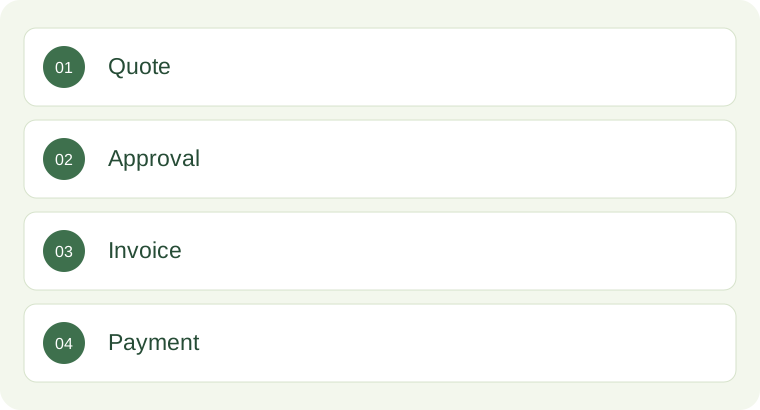
Your customer shouldn’t have to start again every time their enquiry moves from sales to delivery or accounts. I want the agreed work, responsible person and payment status to stay connected. I’ll walk you through the handoffs from quote to approval, booking, invoice and recorded payment. We’ll also keep an accepted quote separate from cash received, so your sales view doesn’t give you the wrong picture of the bank balance.

Published · Updated

Give the opportunity a continuous identity
A typical service enquiry may pass through a website form, a phone conversation, a quote, a booking, delivery and an invoice. If each step is created separately without a clear link, staff spend time reconstructing the story. The customer may need to repeat information, and you may struggle to see which marketing activity led to the work.
Start with a durable opportunity or job reference. Use it to connect the enquiry with the relevant quote, agreement, appointment and invoice. The customer record identifies the person or business, while the job reference distinguishes this piece of work from earlier or later requests. This becomes particularly important when one customer has several properties or multiple services.
The objective is continuity, not forcing every activity into a single product. A CRM can manage the opportunity while specialist estimating, scheduling and accounting tools perform their own functions. What matters is that the authorised team can follow the relationship between records and know which system owns the current version of each important fact.
Confirm scope before producing a polished document
A professional quote is only as useful as the scope behind it. Record what the customer requested, what the business has assessed, what is included and what remains uncertain. The appropriate level of detail depends on the service. A site-dependent renovation usually needs different preparation from a standard service appointment.
Separate an indicative conversation from a formal proposal. Staff should know which information they may provide and who approves pricing or scope exceptions. A system should not generate a final-looking document from incomplete discovery simply because a template is available. The customer needs to understand whether they are reviewing an estimate, a proposal or an agreed scope.
Keep assumptions visible. If access, measurements, service area or timing must be confirmed, record that condition in the appropriate place. The wording and commercial terms should be reviewed by the business's relevant professional advisers. The operational workflow can preserve the approved information, but it should not be asked to make legal or tax decisions on your behalf.
Make approval a recorded event
A quote being sent is not the same as the customer accepting it. Decide what acceptance looks like in the business and how it is recorded. The process should preserve the version, the date, the person involved and any conditions or changes that still need resolution. An informal message might need review before the team treats the work as ready for scheduling.
When a customer asks for a change, make the version history understandable. Staff should not have to guess which attachment is current or compare several conflicting messages. The record should show whether the revised scope has been approved and whether the price or timing has changed. This protects the handoff to delivery and reduces avoidable confusion.
For a hypothetical bathroom project, a customer might accept the original scope but request different fixtures. The estimator needs to confirm the revised specification before the booking is treated as final. A connected workflow can flag that the decision is pending, rather than moving the opportunity forward solely because the customer used the word yes in a message.
Hand the agreed work to the delivery team
Once the business's acceptance conditions are satisfied, the delivery team needs a concise operational handoff. Include the customer and site details, agreed service, relevant documents, scheduling requirements and the person responsible for the next step. Do not send the entire sales conversation and expect the team to identify the important commitment.
Confirm receipt of the handoff. A job is not safely assigned merely because a notification was sent. The receiving person should know where to find the authoritative scope and how to report a problem. If the work cannot be scheduled, the opportunity needs a visible exception rather than remaining in a stage that suggests everything is progressing normally.
Keep the customer informed through an agreed channel. Messages should accurately reflect the status. A tentative booking request should not be described as a confirmed appointment. If a change affects the customer, identify who communicates it and where the decision is recorded. The system supports the operation, but accountability remains with the team delivering the service.
Separate invoice creation from payment collection
An invoice records a request for payment under the business's approved commercial arrangements. A payment link provides a route to pay. Neither establishes that the customer has paid. The workflow needs to distinguish document preparation, review, issue, collection and reconciliation, using the status from the appropriate system.
Stripe's official invoice documentation, for example, describes stages including draft, open and paid, with additional outcomes such as void or uncollectible. These are useful platform concepts, but the business still needs to decide who may prepare or finalise an invoice and how the invoice relates to the underlying job. Other accounting or payment systems may use different processes.
Keep tax settings, supplier details and legal terms under the control of the business and its advisers. An automation can copy approved data and request review, but it should not guess registration details, tax treatment or payment conditions. Those decisions should be settled before live customer documents are issued through the connected workflow.
Handle partial payments and changes deliberately
A payment process may involve a deposit, staged invoices, a balance, a refund or an adjustment. Decide how those events affect the operational record. A deposit received does not necessarily mean the full job is paid. A payment that failed should not leave a record marked complete merely because the customer opened the payment page.
Where status updates are connected automatically, test the exact event being used. Stripe's status-transition documentation distinguishes invoice-related events and resulting statuses. The practical question for you is which event confirms the fact the workflow needs to record. A notification that an invoice was sent answers a different question from confirmation that payment was received.
Give exceptions a named owner. If the customer pays by another approved method, accounts may need to reconcile it before the CRM is updated. If a refund changes the commercial outcome, decide which report should reflect it. The team should not have to improvise a different process for every payment that falls outside the easiest online-card scenario.
Keep reporting definitions commercially honest
A pipeline value, an accepted quote, an issued invoice and collected money describe different stages. Report them with their correct labels. Combining them into a single revenue figure can make performance appear better or worse than the records justify. It can also confuse marketing decisions by mixing work won in one period with payments received for earlier projects.
Consider a hypothetical roofing company that wins a job in November, completes the work in December and receives the remaining payment later. The CRM should preserve the accepted date and value. The delivery system should record completion. The payment record should show collection. A useful report can show all three without pretending that they occurred on the same day.
Agree which measures will guide marketing and operations. Cost per enquiry, cost per accepted job and collection status can all be useful, but they answer different questions. Where data is missing or delayed, show the limitation. Clear reporting is more valuable than an exact-looking return calculation built from inconsistent definitions and assumptions about payment.
Keep document access practical for the people doing the work. A technician may need the current agreed scope but not every commercial discussion. Accounts may need the issued invoice and payment reference without unrelated customer notes. Define these views around responsibilities. When the same customer has several jobs, make the job reference prominent on each document so a payment, change request or delivery update is not accidentally applied to the wrong piece of work. Small identification details support a much clearer operation.
Test the whole journey before relying on it
Use a labelled test opportunity to move through the agreed workflow. Create the enquiry, prepare a draft quote, record an approval, assign the job and check the invoice and payment stages in an appropriate test arrangement. Verify that the correct customer and job references remain linked at every step. Do not treat separate successful screens as proof that the complete handoff works.
Include a revised quote, a cancelled booking and an alternative payment route in the test plan. Check who receives each notification and whether the next action is clear. Staff should know how to pause a faulty automation and continue the work manually. The fallback matters because customers still expect service when a connection or platform is unavailable.
We can help connect the acquisition and operational journey around the business's approved tools and commercial process. We map enquiries, CRM stages, booking handoffs and supported invoice or payment-status connections without replacing professional accounting or legal decisions. The result should be a clearer record of what was requested, agreed, delivered and paid, with ownership visible along the way.
Let’s put this to work in your business
Choose one recent job and trace its quote, approval, delivery and payment records. I’ll help you see where the information separates or gets copied by hand. We can scope the supported CRM, document and payment-status connections around your approved process. Your accountant or adviser sets the relevant commercial requirements, and we make the operational handoff easier for your team to follow.
KEEP READING

Give every missed enquiry a clear next step
When someone calls and nobody answers, I don’t want your team guessing who should call back. I want one record, one responsible person and a clear next action.

Connect your enquiry process without replacing everything
You don’t need to replace software that already works just because you want better marketing. I’d rather start with the handoff that’s missing.

Choose a CRM that fits your business before replacing what already works
If your team already has software it trusts, I won’t ask you to throw it away just to use our CRM. First, I want to see where enquiries get lost, where people repeat work and which system owns each decision.