Social & content
A weekly content plan you can approve in one sitting
I want you to stay in control of what your business publishes without spending every day chasing captions and images. When we organise your social content, the aim is one clear weekly review: see the finished material, approve it or request changes, then let us handle the publishing. Here’s how I’d structure that routine so your photos, Reels, Facebook updates and Google Business posts keep moving without taking over your week.

Published · Updated

Agree what the approver is responsible for
Choose one primary approval owner and a backup. They should know the business well enough to confirm that services, names, offers and expectations are accurate. Other people may need to review particular topics, but avoid giving every routine post an undefined committee of decision-makers.
Write down the boundaries. The marketing team can propose the message and creative treatment. The business confirms the facts and whether the content appropriately represents its work. Industry-specific or sensitive claims need the appropriate internal review. The approval owner is not expected to rebuild every design personally. A clear division of responsibility lets the agency do the production work while you retain control over what is published in its name.
Set a review window with a practical deadline
Choose a predictable point each week for reviewing the upcoming content. Allow enough time afterwards for revisions, a final check and scheduling. Do not make the approval deadline identical to the publication time unless the content is genuinely time-sensitive and the team has agreed that exception.
State what happens if approval does not arrive. A sensible default is that unapproved content remains unpublished, rather than treating silence as consent. The production team can flag the affected items and the business can decide whether to move the schedule. A predictable routine reduces rushed decisions. It also protects you from feeling that every message from the content team requires immediate attention, even when the planned publication is several days away.
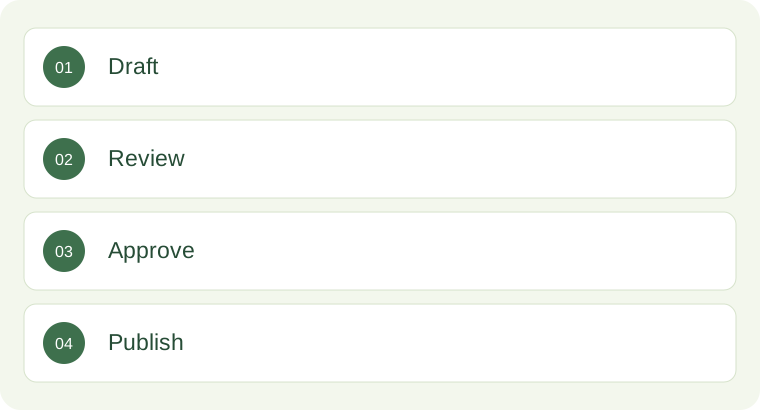
Prepare a complete approval item
Each item should include the final image or video, caption, destination channel, proposed date, link and intended purpose. If the post refers to a current offer, include the approved offer details. If it depends on a project photograph or testimonial, confirm that the required permission has been recorded.
The approver should be able to understand the proposed publication without searching through separate folders and conversations. A Reel preview without its caption is incomplete. A caption without the image crop is also incomplete. The customer will experience the parts together, so they should be reviewed together. Preparing the complete post makes your review quicker. You should not have to approve something without seeing the caption, image and planned channel together.
Group the week so the pattern is visible
Show the proposed week in one view. This makes repetition, gaps and conflicting messages easier to notice. Several individually acceptable posts may still produce an unbalanced week if all of them repeat the same offer or use the same photograph.
Use a small set of themes such as people, process, service questions, approved work and local updates. The mix does not need to be mathematically equal. It should fit the business’s priorities and the material available. A clinic may need a clear explanation of how to arrange a visit. A trade business may have useful project preparation content. Review the week as a sequence of messages from one business, rather than a pile of unrelated creative assets.
Review facts before preferences
Start with the details that must be correct: business names, staff roles, service descriptions, coverage, contact information, dates and links. Check whether the post implies an availability or outcome the team cannot support. Correct these issues before debating a preferred photograph or a small stylistic change.
This order keeps the review focused. A factual problem can make an otherwise attractive post unsuitable for publication. A stylistic preference may be useful but less urgent. Where the topic requires clinical, technical or other specialist approval, route it appropriately rather than relying on a marketing writer’s confidence. The review is strongest when everyone knows which decisions they can make and when a qualified person needs to be involved.
Preview the actual format, especially for Reels
A Reel, a square image post and a Google Business Profile update do not present information in the same way. Review the crop, text placement, captions and destination link in a preview that resembles the intended output. Check whether important wording is hidden by interface elements or becomes too small on a phone.
For video, watch the complete sequence. Confirm that the opening message, sound, captions and closing action agree. A good cover image does not guarantee that the rest of the clip is accurate or readable. For image posts, check the relationship between the visual and caption. The goal is a coherent customer message. Do not approve only the part that appears in the notification and assume the rest has already been checked.
Use three clear decisions
Give every item an explicit status: approved, changes requested or not approved. Add a reason when changes are needed. “Approved once the telephone number is corrected” is an instruction to revise and recheck, not the same as approval of the current version.
A central planner or agreed approval tool should hold the decision against the actual item. Avoid relying solely on an emoji buried in a long chat. The point is not bureaucracy. It is to remove uncertainty about whether a particular version can be published. When a team manages several channels and multiple clients, that clarity prevents an avoidable mistake from becoming a public correction or a difficult conversation about who thought permission had been given.
Make feedback specific enough to reuse
Tell the production team what needs to change and why. If the caption sounds unlike the business, identify the words or tone that are wrong. If a photograph does not represent the service accurately, explain the mismatch. Specific feedback helps the next draft and improves later work.
Separate one-off corrections from changes to the standing brief. A misspelt name needs a local fix. A decision to stop promoting a service should update the content plan, website information and other relevant marketing. If feedback repeatedly returns to the same issue, review the source brief rather than correcting each post individually. Your feedback should improve the next draft. You should not need to rewrite the same generic captions every week.
Keep the approved version intact
Once an item is approved, material changes should trigger another review. Adjusting a minor formatting issue is different from changing the offer, replacing the image or rewriting a claim. Agree which routine production adjustments are allowed and which need your decision.
Keep version history where practical. The team should be able to identify which caption, asset and link were approved. This is especially important when the same creative material is adapted for several channels. A Facebook version may contain different wording from an Instagram caption, so approval should cover the relevant variations. Clear version handling protects your control and gives the production team confidence that it is publishing the intended message.
Check publication and hand off responses
Assign someone to check that scheduled material actually appears on the correct account with the correct crop, text and link. A connection or scheduling issue can occur even after a good approval process. The final quality check closes the loop.
Also decide who handles comments and messages. The content team may answer routine questions within agreed boundaries, while service assessments and other specialist questions return to the business. Genuine enquiries should enter the agreed customer process rather than remaining only in a social inbox. A successful post can create work for reception or sales. The publishing plan is therefore incomplete unless the team knows where those conversations go and who owns the next action.
Use the next review to learn from the previous week
Begin the next approval cycle with a short observation, not a long performance lecture. Which questions did the content produce? Did any message confuse people? Which assets were useful in real customer conversations? Use channel measures as context and keep them separate from enquiry or revenue outcomes.
Do not overhaul the plan because one post received fewer reactions. Look for patterns across relevant activity and enough time. The useful learning might be that customers need a clearer explanation of the first appointment, or that the team needs fresh process photographs. Feed that information into the next production brief. Approval becomes more valuable when it connects the content programme to what the business is hearing from actual customers.
Make weekly approval part of the service, not extra homework
A good routine lets you make informed decisions in one place and lets the production team keep work moving. It depends on complete items, a clear owner, specific feedback, controlled versions and a final publication check. The business stays in control without having to become its own content agency.
We can plan photography and video, create posts and Reels, organise the weekly approval view and publish approved material across relevant channels. We connect the process with the website, Google Business Profile and enquiry management so that the content reflects the operation customers will actually encounter. Start by reviewing your current approval bottleneck: missing assets, unclear ownership, last-minute feedback or an inconsistent brief. Then build a routine that addresses that specific problem.
Let’s put this to work in your business
Bring a typical week of content and show me where approval gets stuck. I’ll help you agree the review window, the person who approves and what each item needs before you see it. If we manage your content, we’ll prepare the photography, posts and Reels around that routine. You make the final decision on the material that represents your business.
KEEP READING

Plan one business shoot that gives your marketing months of useful material
Before we pick up a camera, I want to know what your customers need to see. A useful shoot gives you real evidence of your team, your work and how you look after people.

A practical social media system: from the shoot to approved posts
You shouldn’t have to become your own content manager to keep your business active online. We can plan the shoot, create the photos, posts and Reels, then bring the finished week to you for approval.

Clicks, enquiries and bookings are different numbers
If your ads report looks healthy but your diary tells a different story, I want you to look beyond clicks.